Book Review
Will Self
The Quantity Theory of Morality
Self's latest novel continues his assault on his native land’s philistinism, and the result is an uneven but at times brilliant send-up of London’s cultural elite.
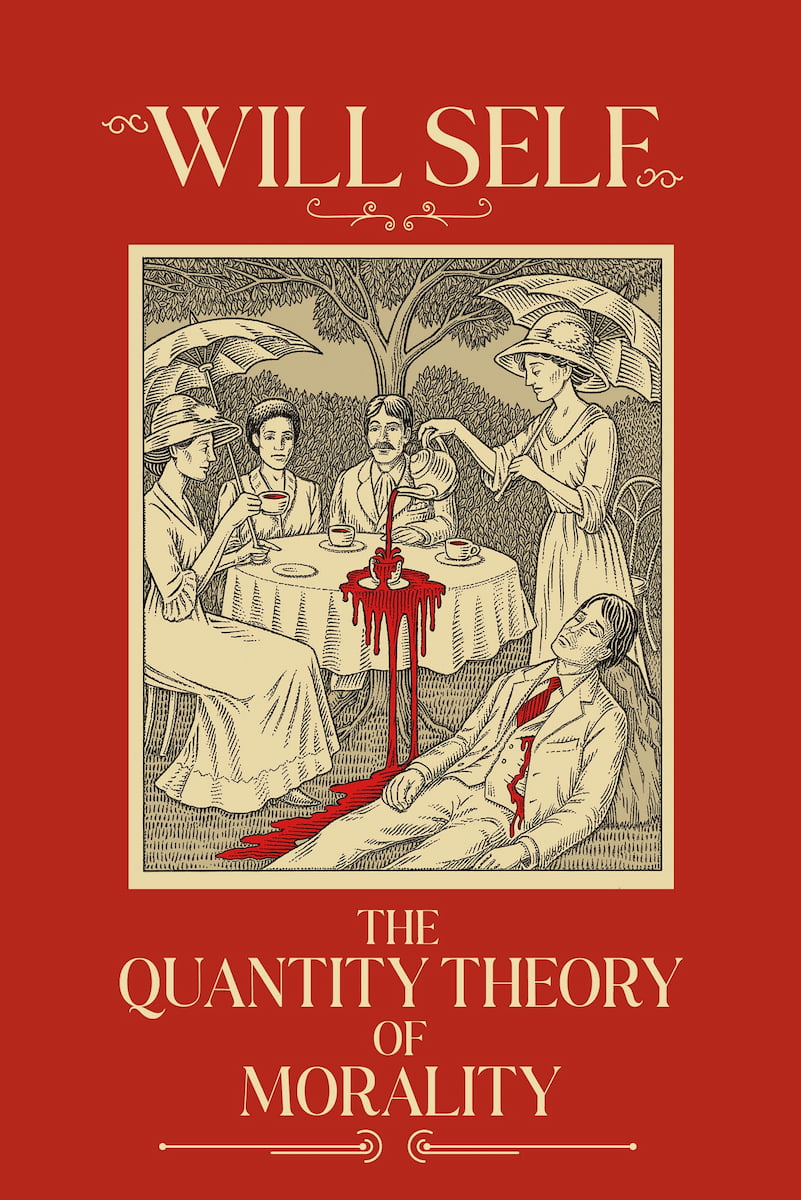
Will Self has long had an air of anachronism about him. Since he first emerged as a novelist, essayist and public intellectual in the early 1990s, he has refused all compromise with a contemporary culture he views as increasingly intolerant of the complexity on which long-form writing depends. He proudly cites Joyce, Proust and Kafka, twentieth-century figures par excellence, as his literary talismans, and remains convinced that a high modernist approach, with its eschewal of straightforward authorial omniscience, is the best means of capturing our dizzyingly fragmented, media-saturated world. Until recently, he was a prolific presence on those quintessentially twentieth-century media, radio and TV, where he cut a singular figure. A Londoner through and through, but one whose tastes were distinctly Continental, he stood out for his remarkable verbal felicity and eloquent dressing-downs of political and economic elites. Even the drug addiction with which he struggled for years felt rather last century; Self has frequently been called a “rock star”, a term few bandy about today.
That sense of anachronism extends beyond Self’s literary tastes to the role he casts himself in: the belated modernist scourge of his native land’s philistinism. If Self’s view of British culture could be summed up in one word, it would be mediocrity. In his estimation, only a culture as hopelessly parochial as Britain’s could hold up a writer like George Orwell – the “Supreme Mediocrity”, as he called him – as a literary icon. At the height of Self’s fame, his curmudgeonly provocations, however justified, about the ever-imminent death of the novel, “sub-aspirational” readers, and British anti-intellectualism – not to mention the “health warnings” about difficulty that emblazon his novels – could be irksome. But from the perspective of today, with attention spans eroded beyond what even he, at his gloomiest, could probably have imagined, his remonstrations now appear almost prophetic.
Running through Self’s criticism – newly sharpened by the rise of AI-generated prose – is a suspicion not simply of subpar writing but of a culture of frictionless readability: prose that demands little of its producer and asks even less of its reader. Perhaps the most unsettling thing about writing produced by tools like ChatGPT or Claude is not that it is bad, but that, under certain conditions, it can seem rather good. “Slop” might best describe the profusion of AI-generated detritus on our increasingly enshittified internet, but it is wholly inadequate as a description of the simulacra of competent prose – however wooden or artless – that have already embarrassed several publishing companies. Much of this prose would no doubt conform seamlessly to Orwell’s dicta laid out in his 1946 love letter to simplicity, Politics and the English Language.
With his latest novel, The Quantity Theory of Morality, Self continues his assault on Orwell’s “manifesto of plainspoken common sense”. Though not quite as formally radical as his more consciously modernist Umbrella Trilogy – a series which set out to explore, in his own words, nothing less than “the dialectical relationship between technology, mental illness and war” – The Quantity Theory is nevertheless full of recognisable Selfisms: hypotaxis to rival Proust’s; abundant gallicisms (“moue”, “farouche”, “surcease”, “debouche”, “benison”); recondite English terms (“spavinous”, “bedizen”, “perambulate”); and plentiful non-standard punctuation. Less charitable readers are apt to dismiss these features as tics, but at least Self can call them his own.
For those unfamiliar with Self’s wider corpus, The Quantity Theory of Morality reprises, mutatis mutandis, a pseudo-philosophical theory first sketched in his debut short story collection, The Quantity Theory of Insanity (1991). Expounded by Dr Zack Busner, an eccentric Mitteleuropean émigré and psychiatrist – now a recurring character in Self’s fiction – the theory holds that any one social group is endowed with a finite supply of sanity. The conceit heralded Self’s brand of absurdist fiction, with its women who grow penises and men vaginas (behind their knees), as in Cock and Bull (1992); chimpanzees ruling London, as in Great Apes (1997); and its misogynistic diatribes which somehow end up as Scripture, as in The Book of Dave (2006). Self’s latest novel transposes this conceit from the psychiatric to the ethical register.
The result is an uneven but at times brilliant send-up of London’s cultural elite. Plot-wise, a lot seems to happen, but mostly from within the confines of lavish Hampstead dinner parties and Mediterranean holidays, where a vacuous, self-absorbed, alcoholic and chronically unfaithful upper-middle-class set convene to boast and bitch. At least in this regard, the novel ostensibly draws on the comedy of manners genre, much of its substance consisting of banter and repartee. Self would never write such a novel, though, at least in the conventional sense; after all it is precisely this distinctly English tradition and its faux realism that he has repeatedly chided. Instead, he filters it through the modernist and post-modernist forms that he has long claimed are in fact the superior means of conveying experience as it actually is.
A textual hall of mirrors, the novel comprises chapters that are each narrated by a different character and thus necessarily from a different perspective. There are verbatim reiterations, but also surrealist embellishments. In one version, all the formerly male characters are now women. In a later cycle, following Busner’s warning that the group’s “morality quotient” is running dangerously low, one of the retinue dies.
Self has been gravely ill in recent years, having been diagnosed with a rare form of blood cancer, polycythaemia vera, in 2011. That reflections on death and its trappings should be so prominent a feature of his most recent novel will therefore come as no surprise. Indeed, Self goes so far as to imagine his own obsequies – or, to be exact, those of his narrator, “Will”. While fertile ground for the kind of black comedy at which Self has always excelled, these sequences are also some of the book’s most poignant and serious; for all his iconoclasm, Self the satirist is no nihilist. Jewish liturgy and burial rites – Self is Jewish on his mother’s side, and The Quantity Theory of Morality is also a reckoning with this part of his identity – are commended in particular for how they marry the spiritual and the material, refusing any “denial of the brute fact that all things must pass”. This is contrasted with the ghastly conviviality of the funerals that follow the demise of one of his own in the liberal intelligentsia.
The denial of death, for Self, is not so much a theological as a political matter. A society that conceives our finitude – the defining fact of our existence – as “first and foremost always an embarrassment”, rather than as the existential horizon from which meaning itself arises, is surely one devoid of ethical seriousness:
Like many contemporary funerals born of the denial of death, this one was delightfully informal – after the eulogies, people just stood around muttering nothing for a while, stunned yet again by the way, if you void life of any serious talk for ninety-nine percent of your waking existence, it’s so very difficult – if not impossible – to summon any profundity when you need it, beyond pro formas and mere politeness.
This wilful ignorance is, for Self, the root of all contemporary evil. It is what underpins the hypocrisy of a liberal dispensation for which morality is reducible to preference. As Dr. Busner puts it, educated people in the West “don’t know much about morality, but they know what sorts of actions they personally like – y’know, the ones that make them feel good, and they regard these as estimable, just as they regard those who perform these actions that make them feel good as, de facto, good people”.
The final third of The Quantity Theory of Morality is as directly political as anything Self has written. Britain has lurched into dictatorship under the “Nationalist Trust”, a British neo-Nazi party with a headquarters at Poundbury, its Theresienstadt. Jews and foreigners are being rounded up by HOVIS – “The Home Office Visitor Inspection Service”. Self grudgingly acknowledges the Orwellian inheritance here, mentioning both Orwell’s “evergreen fantasy of grotesque totalitarianism”, and his supposed plagiarism of Yevgeny Zamyatin’s We, but interleaved with these rather familiar dystopian tropes are barbs that are clearly Self’s own: about green politics, trans rights, Gaza, AI, climate breakdown.
Though some of these land, others fall flat, in part because the targets are such low-hanging fruit. Indeed, at times these polemical sallies read as inadvertently confessional, so much so that I had the uneasy feeling that, through them, we are getting a version of Self as he might have been, had he ever reneged on his self-imposed exile from social media platforms:
He took to social media, and, partly in search – as are so many in this increasingly anonymizing era – of what might serve him as an ‘identity’, and mostly to substitute for his, and the medium’s that had sustained his, waning popularity, became radicalized.
Not by any coherent ideology – no matter how pernicious – but purely his own narcissism and sense of burning grievance. Once addicted to the likes, he was ceaselessly riven and re-riven by the divisive sexual politics of our era.
As we know, the virtual self is rarely an improvement on the actual one. In Self’s own case, the conditions for Twitter-enabled self-immolation – an acrimonious divorce at the height of the #MeToo moment, followed by his self-described cancellation – were perfectly in place.
Perhaps not coincidentally, The Quantity Theory of Morality’s coda, in which politics retreats significantly, is among its strongest and most moving sections, with Self returning to his literal home in North London, and his proverbial one, psychogeography. His London dérives never excluded the city’s netherworld, and his deep attachment to the Tube network is tangible in the novel’s climax, in which he waxes nostalgic over the sheer topographical oddity and “pure steampunk” of Highgate station, with its “concertinating gates, beside which were brass operating dials, such as you might imagine finding on the bridge of Robur’s Albatross, or Nemo’s Nautilus”. He has previously said that it is difficult to convey the extent of his love for the Tube; here, in a passage deliberately cast as a profession of faith, he comes about as close as he can:
It’s true what the ancients said: seeing is believing – and I believe in the moquette, the grooved floor, the lighting that changes from time to time while remaining always the same. I believe in the dead man’s handle, ever hovering between the palms of the holy driver, who awaits martyrdom in the Others. Yet, I lend my greatest credence of all to that smell, a synthesis of a sepia tone, with the taint of damp flannel, and the stench of singed rubber, and the desiccation of antediluvian soot, and the Googleplex glimpses of the ghosts of a million, billion cigarettes.
He is, as ever, nostalgic for the twentieth century’s grittier modernity. For Self, the “very epidermal tattiness of poster peeling away from poster peeling away from poster”, as he once wrote in The Guardian, constitutes the Tube network’s peculiar glamour, and one struggles to imagine him speaking in such glowing terms of, say, the Underground’s most recent mise à jour: the streamlined, stainless-steel calm of the Elizabeth line.
If one were to posit a literary analogue, the point is clear: a Self more accommodating to contemporary preferences for concision and polish would surely be a lesser one. Insofar as such a capitulation is almost impossible to imagine, he remains a welcome anachronism. Yet to be an anachronism is to be necessarily out of joint. At its best, Self’s style represents a fertile ressourcement of a modernism that still has something to offer. At its worst, it can shade into Joyce karaoke. To produce originality anew, not merely remember it, is a formidable challenge. In an age of industrialised imitation, it is an increasingly urgent one.
If you enjoyed this article, please consider supporting our work. You can also subscribe to our newsletter here: