Book Review
Laura Vazquez
The Endless Week
Laura Vazquez's defiantly diffuse novel makes us constantly aware of how vulnerable to pain our soft bodies are, and how much our freedom is at the behest of others.
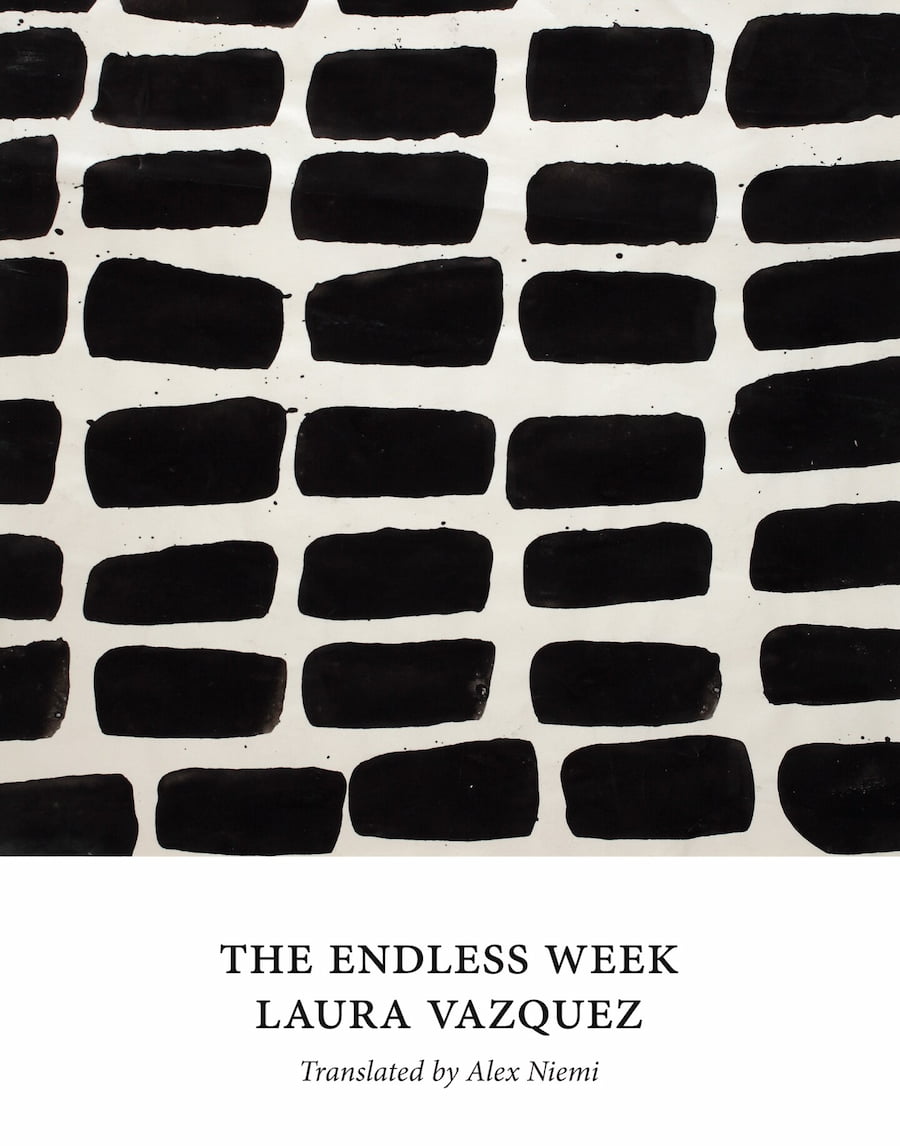
A head doesn’t just fall off, it can’t fall off. It’s connected to a thin string that goes all the way down to a person’s feet, and if the head falls, so does everything else.
Thus begins The Endless Week, and thus will Laura Vazquez continue throughout a novel in which the bizarre experience of being a person is explored with the persistence of curious children. The two characters who are central to the novel, Salim and his sister Sara, are indeed curious children. They are curious to know more regarding the whereabouts of their mother, who left them several years before this story begins, and from whom they have not heard since. But the search for their mother is never more than another “thin string” holding together a defiantly diffuse plot, the resolution of which is almost comically anti-climactic and incidental.
The children’s behaviour is also curious, forged from within an unsupportive, watchful world. At the heart of that world is their father, a deeply damaged man who seeks order through cleanliness (with a sponge for every occasion).
This father’s lips produced short, abrupt sounds against his gums. He wrung out a sponge and dunked it in water, wrung it out and dunked it again. He pointed a fork at the ceiling and said: You need to understand that you can’t just do whatever you want.
At every moment in the novel, we are made aware of how partial an understanding the protagonists have of existence, and how useless it is to hope that we might ever transcend our ineluctable, material bodies. Vazquez uses a passage from Corinthians for the epigraph that opens the book:
For now we see only a reflection as in a mirror;
then we shall see face to face.
Now I know in part;
then I shall know fully, even as I am fully known.
But with no God to guide us towards a moment of exquisite insight about ourselves, we are bereft. In the most disturbing parts of the novel, the author makes us feel how vulnerable to pain our soft bodies are, and how much our freedom is at the behest of others. Even as we wish to be alone, or think ourselves to be so, we are within the force-field of others: “You think you’re walking down a street, but you’re walking in the thoughts of a stranger.”
Salim’s sister Sara is no more at ease with her position in the world than he is, and lives a semi-hermetic existence, with her communication largely confined to an online connection with Jonathan, a boy of similar age, with whom they both interact. Eventually, they will take to the road with Jonathan in an effort to locate their long-absent mother.
As with much else in the novel, the subject of the mother, her reasons for leaving, and the quest to find her are dealt with tangentially. Far from facilitating a linear narrative, the chronicling voice is always discursive, and the children’s search for their mother is like a cursory nod to what a novel is generally thought to be. All the while, it becomes a means of allowing for digressions on any topic that comes to the fore. Indeed, there is an impression that Vazquez is freely improvising much of the time, with the confidence of a writer who can start a sentence without knowing where it will lead.
With little need to observe traditional narrative obligations, the plot becomes a lattice around which the tendrils of a rampant, exuberantly floriferous set of wild imaginings can spread. The novel is sustained by so many original observations that the wish to quote endlessly could result in a Borgesian review in which there is no option but to quote the entire book. But, for now, let us linger on just two: “I feel like water forgives me when I drink it.” And: “There’s air, isn’t there? In the air. There’s a lot of air, isn’t there?”
There is much that is dream-like in the illogical drifts of this novel, and several dreams are detailed with all their arbitrary juxtapositions and casual implausibility. While the novel is never whimsical, it frequently has a pleasing outlandishness.
I walk through the store, but it’s a loop, there’s no exit. In one aisle, Michael Jackson is there alone, he asks me where the hammers are. He’s speaking to me in Arabic, and he’s crying. He says: I was unlucky, honestly, I was unlucky. He says: I’m still alive, but I was unlucky.
To counteract the dreaminess, however, there are several nightmare-like scenes. These are all the more shocking because we are confronted by sustained violence against children. In one instance, it is used by a father of seven who insists on complete compliance from his children: “I have to shave them because of lice and I beat them every day. I keep them up against the wall, otherwise they take up space. You can plainly see I don’t have enough space. He said: I love them. I love even the misshapen ones.”
Even worse is the brutality once inflicted on Salim and Sara’s father, when he was young and being looked after by an older female cousin. The sustained nature of this cruelty may explain much about the father’s well-meaning but fearful state, his caution against his children making any attempt to explore far from their home, and his compulsion to constantly wash every surface within reach: “if there are any disasters, we’ll call the firemen, so the firemen will see the house is clean, they’ll say: These people are dead, but they’re clean.”
The intention behind the portrayal of extreme violence is puzzling. Perhaps it is another means of accentuating the susceptibility of the human body, which is contemplated in a more sympathetic, if eccentric, fashion for most of the novel. In both registers, the understanding conveyed is that physical experience creates our reality and, therefore, our understanding of the world and our position in it. The horrors of abuse can never be forgotten or diminished by developments later in life. The ways in which concealed pain will manifest itself are many, ranging from self-banishment to revenge. The two fathers portrayed in the book may both have explanations for their contrasting behaviours. But neither has gained the insight that will lead them to serenity.
One other character lends a strand of narrative coherence to the novel: the maternal grandmother of Salim and Sara, who lies dying in a nursing home, but is allowed sub-chapters of first-person narration, which enable us to recognise a mind that is very much alive inside her rapidly failing body. Yet, she must endure the indignities of advanced old age and the attendant sickness as she hovers between life and death, even less free now to control her body’s mutations than she was when young. In death, as she is prepared for burial by a funeral director, even the minuscule element of control and consent she once had dies too.
But yet, at the scene of the laying out, there is grim, absurdist humour as there often is in this extraordinary and boundless novel. Regarding death, for example, the suggestion is made that, “If we don’t die, someone dies in our place, but either way someone always ends up dead. The dead preserve the living. Every year, around 275,000 pedestrians die in a car accident around the world, once 275,000 people are dead, nobody else can die, you have to wait until next year. You can throw yourself under a car, a bus, you can try, but you won’t die.”
An episode in which the father has to meet with a social worker because of Salim’s repeated absence from school provides further amusement, as the social worker’s earnestness contrasts acutely with the father’s bewilderment:
Listen, sir, you have to understand that the future of your son is at stake, and the future of a child is the future of a municipality and the future of the planet, given the globalized world we live in. Our wish at the Office of Family Affairs, our sole wish, can be summed up by the following image, listen carefully: children holding hands and moulding the world of tomorrow. Don’t you agree? The father said: Yes.
The social worker said: I must ask you to repeat that back to me, sir.
The father said: Children holding hands and moulding the world of tomorrow.
However much the characters might wish to remove themselves from the routine interactions of daily life, they exist in the present time, with its inescapable technology, and so they are constantly acquainted with the events of the world as witnessed through screens. How can they, or we, process what we see without being overwhelmed?
The baby opened its mouth, but it couldn’t cry. The woman showed her breast, it was dry, it was empty, she said: Give us a drop, she was talking to the camera… She said: You’re watching us die on your phones, you are watching us die from your couches. And that’s what he was doing, he was watching people die on his phone, sitting on a couch.
It is through the same technological means that Salim and Sara become acquainted with Jonathan, who becomes their sole friend and who has his own set of problems. To judge from the awful things he imagines himself to have done, he may well have OCD. But, like many people in states of confusion and loneliness, all three are both consumers of social media and ‘content providers’, awaiting the approval of strangers and sometimes getting responses that run contrary to the expected abuse. We are, after all, complex creatures. We use a variety of mediums with the hope of objectively knowing ourselves as others do: conversations, writing novels, and interacting on social media platforms. Sara and Salim are subject to the increasingly familiar sense of observing themselves being observed. The reflecting mirror becomes a filtered simulacrum.
The Endless Week is not what is thought of as a social realist novel. Yet, for all its illustrations of human strangeness, or because of them, the novel is more real than the average, well-written but bland exploration of relationships and selfhood in the modern world. Vazquez has written a remarkable, strange - remarkably strange - novel (assiduously translated with immense imaginative depth by Alex Niemi) that digs deeply into our commonplace dilemmas. There is nothing here that is any less strange than in the greatest of the mediaeval paintings. They too found the needs and impulses of their bodies strange. Most likely, they also found the workings of their minds even stranger as they responded to the barbarity of daily life.
If you enjoyed this article, please consider supporting our work. You can also subscribe to our newsletter here: