Book Review
Deborah Levy
My Year in Paris with Gertrude Stein: A Fiction
Layers of unknowing and fabrication echo through this initially enticing, yet ultimately annoying book.
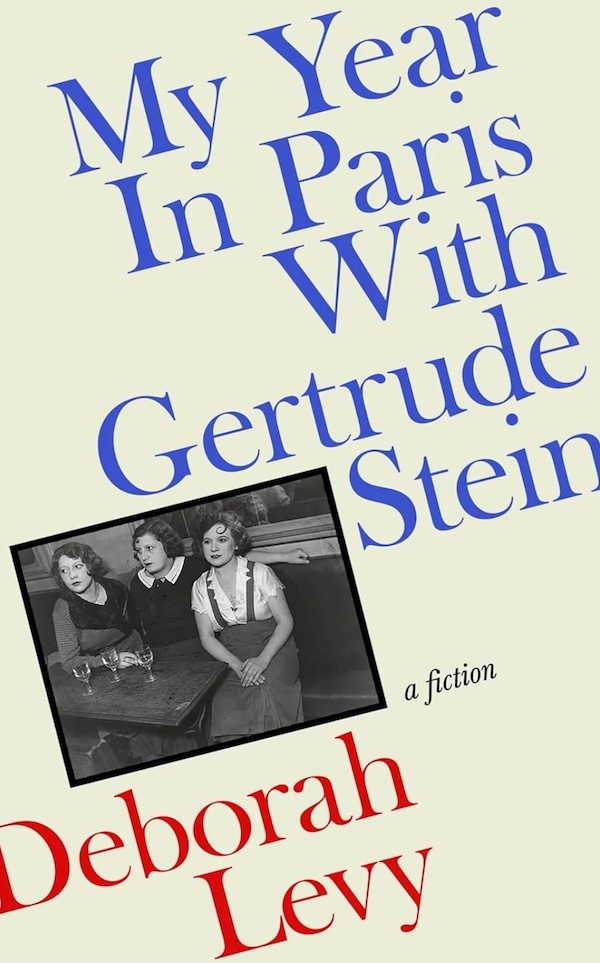
Friends, family, famous people, figures from fiction – how can we ever claim to truly know another person. Do we ever even know ourselves? These musings haunt the heart of Deborah Levy’s latest work, My Year in Paris With Gertrude Stein. The book’s subtitle: a fiction; hints at the layers of unknowing and fabrication that will echo through the book. For a start, how much is fictional in this fiction of Levy’s? We know that Gertrude Stein existed, but what about the narrator herself? Who owns that “My” of the year in question?
Stein herself was a reinvented creature, moving away from her American birthplace, trust fund in tow, to set up both home and salon in Paris. A novelist, poet, playwright and collector of art, she ditched her brother Leo to step into the limelight and hang out with the likes of Pablo Picasso, Henri Matisse and Ernest Hemmingway. She met James Joyce but, reportedly, was dismayed that Sylvia Beach had published Ulysses and not Stein’s own opus, The Making of Americans. An attempt to get Virginia Woolf to publish it through the Hogarth Press also failed.
Instead, Stein came to fame with her The Autobiography of Alice B. Toklas, another puzzle of a book. It was written in the voice of Stein’s life partner, Toklas, a literary trick that gave Stein the chance to present herself in the starring role. In the voice of Toklas, she could, quite literally, write her own life, creating the stage on which to star. And there were stellar moments. Picasso painted Stein, Pierre Balmain dressed her, she collected Matisse before almost anyone else. She also collaborated with the pro-Nazi Vichy regime during the Second World War, and appears to have thrived on a cocktail of deliberate unconventionality and witty aphorisms. Virginia Woolf didn’t like her, but then again, Woolf didn’t like James Joyce either.
According to Levy’s narrator, Stein didn’t like punctuation and was sceptical of literal associations and meanings. The narrator also bestows her with creative greatness: “Stein and Picasso had made a new language,” Levy writes, likening Stein’s way with words to Picasso’s invention of cubism. A statement like that is certainly enough to make you want to know more. But knowing, as this initially enticing, yet ultimately annoying book implies, is a slippery impossibility.
My Year in Paris centres around three friends. There is the narrator, an English woman who, it appears, has come to Paris to write an essay about Gertrude Stein, a task at which she is floundering. Fanny is a polyamorous French financial high flyer. Eva, a Spanish-Danish illustrator possessed of mesmerising blue eyes completes the trio. Stein and her associates flit in and out of the narrative, sometimes echoing episodes in the present day, sometimes as an antidote – after all, who hasn’t needed at points in their lives to get lost in a good book? “’Oh, we’re all screwed,’ Fanny said when the result from the American Elections hit our screens in Paris. ‘I’m off to scream into the Seine.’ […] I was alone being numbed up by Gertrude Stein.”
Eva has a cat, which she has named “it”, always with a lower case “i”. it has got lost, a conceit which allows for numerous riffs on “what is it?” (a line that also appears in Stein’s Tender Buttons), “what does it mean to lose it?” and so on. “it”, in the book, can be love, purpose, sex appeal, daring, courage, sitting in the shadows, drudgery, capitalism, colonialism, cubism, surrealism, being tempted to smile it off, a sense of who Gertrude Stein was… The list goes on.
The friends go looking for it – the cat. They have dinners in one another’s homes in which elaborate and highly specific meals are cooked, and they aren’t always terribly nice to each other. As things progress, they are revealed to be frequently dishonest in their accounts of themselves, and wrong in their assessments of one another. There is a strand of something interesting here. After all, if we are all self-created fictions, and embellish our lives in ways both small and large, in conversation as well as in print, how can a reliable history be constructed? Biographies are built on anecdotes, references, letters and personal accounts, but where, if anywhere, is fact?
None of this is made overt in the book, and ultimately, the narrative slides away in an irritation of performative gestures. The characters are so self-obsessed, you’d like to shake them, and their personalities seem to be defined by their affectations. Fanny and her lover Lucia have a pug dog that hates moonlight. Eva’s eyes make people go “Awww” and “Owww”, depending on her state of joy or melancholia. Fanny tucks cigarettes in her belt that never seem to get bent out of shape, and wears sunglasses in the dark. Eva brings over-sensitivity to extraordinary levels. Fanny and the narrator have renamed the cat “Bob”. “After her cat went missing, I said, ‘Eva, do you mind that we renamed it Bob?’ She obviously did mind. […] There was something like tears in her eyes but she was upset about things even before she lost it.” “’If I don’t find it I might as well jump into the Seine,’ Eva said.”
“Every century,” Levy writes, “needs an artist to dismantle coherence as we have been taught it and make a space for something new to happen.” The book is peppered with clues about what Levy is up to: flirting with incoherence, realism, repetition, fracture, allusion and gesture, riffing on Stein’s own stylistic constructions. But Levy’s narrator takes what Gertrude Stein wrote about herself, and what other people wrote and said about her, as evidence of truth, even as it becomes increasingly clear that she is often wrong about her own friends. Eva’s husband isn’t “missing”, he is building her a house. The cat’s origins are not entirely what they seemed. Fanny’s narrative of her family doesn’t stand up to scrutiny. Is the narrator’s potential new lover interested in her, or in Eva’s blue eyes?
As with the news of America’s 2024 election, realism intrudes: “like the rise of fascism everywhere, the pigeons were out in full”. Powerful statements are made out of the blue, to be brushed off as quickly as they emerge: “Meanwhile, bombs are falling through the twenty-first century upon the living and the soon-to-be dead. They all have names and surnames in our own century [and] we are on our screens all the time, scrolling, scrolling, scrolling…” And yet, this is “a fiction”. Characters are sketched in words that imply rather than tell, and what are those words actually telling us? Gertrude Stein “was so forward-looking that she never learned to reverse her Ford Model T”. Did the woman never park? Stein had a “wish to kill the nineteenth century […] How did she kill the nineteenth century? With her pen.” Really?
You won’t actually find Stein in these pages, although you may come away thinking that you have, and that she was more significant than she possibly was. For depth, try instead Francesca Wade’s Gertrude Stein: an Afterlife, published in 2025. Stein herself believed that we can’t really know anything, not least because we do not know what we think we know. “And identity is funny being yourself is funny as you are never yourself to yourself…” Stein wrote. “That’s what modernism is all about,” says Eva. “How we put ourselves together.”
In that way this glittering illusion of a book is right on point. It also happens to be one of a recent body of books that seem written to meet today’s shorter attention span. Lines can be just a word. Paragraphs are short. A chapter may be less than a page. Is this the literary equivalent of Instagram? People perform their personalities. Episodes flit past. Timelines slide over one another.
I begin to grit my teeth through the repeated instances of “Awww” and “What is it?” This is unfortunate, because there is other cleverness here that is a sheer joy, nuggets of truth and insight abound. The central problem is that the moments of depth are swamped by all the seeming-depth; and the trio at the heart of the narrative, and those damn repetitions of variations on the theme of “losing it / what is it” are ultimately just too irritating. At the end of the book, the narrator says she thinks she never will write her essay on Stein. “I will write it for you,” says Eva. “I reckon the title will be My Year in Paris with Gertrude Stein.” What is it? The rub of a writer trying to be much too clever for words.
If you enjoyed this article, please consider supporting our work. You can also subscribe to our newsletter here: