Book Review
Paul Celan
Collected Prose
In the aftermath of an historical crisis, reality becomes a task for poetry to recover: that which, as Paul Celan writes, had to be ‘sought out and won’.
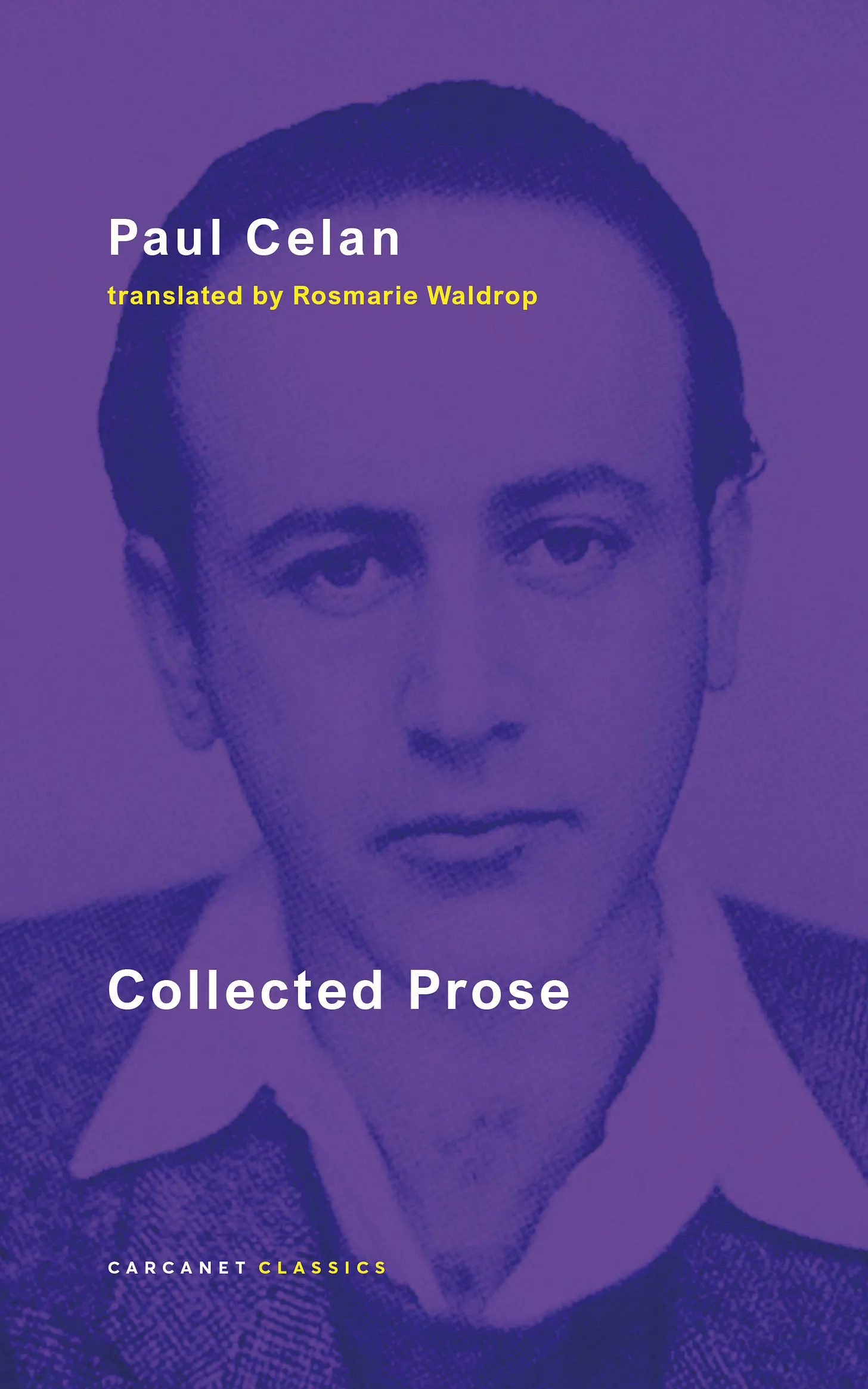
Like any true poet, the mettle of Paul Celan’s (1920-1970) work lies in experience. Poetry’s act of language has its centre at the intersection between the individual—the site of personal time, space, sensation—and the public social structures which form and are formed by those individuals. It is in experience after all that these institutions, practices, and grand terms like “history” are actually lived. Poetry, then, tries to articulate a horizon of significance for our experience of the world, an experience which is always constituted through and mediated by language. Celan was writing, however, at a time when this horizon—from a European perspective—seemed to have been foreclosed by brutal, annihilating forces. In the aftermath of the Holocaust, the imperative for poetry to find a path forward stood in the shadow of the wholesale failure of German culture, and the radical undermining of that project called Enlightenment. It is this effort: to find a route for the poem after historical crisis and a crisis of language that drives the texts gathered in Collected Prose, this new edition re-presenting Rosemarie Waldrop’s translation first published in 1986.
Widely regarded as the preeminent figure in German poetry since 1945 and one of the central figures of twentieth century European poetry, Celan was born in Czernowitz in 1920. He was, it seems unavoidable to state, a survivor who wrote in the language of the perpetrators. Both of his parents were killed—his mother shot, his father most likely succumbing to typhus—during the Holocaust after their own arrest and deportation. Celan, who was not home when his parents were taken, survived internment in a forced labour camp and worked as a medical orderly at the end of the war. After a spell in Vienna he moved to Paris in 1948 and lived there until his suicide in 1970, aged forty-nine. Celan was a voluminous correspondent and kept extensive notebooks, but he wrote very few prose texts. The present volume is a slim one, and its contents eclectic: a couple of speeches, some forewords, an answer to a bookshop questionnaire, a collection of aphorisms, an off-kilter fable of a meeting between two Jews walking in the mountains, and a single sentence of French invective. On first sight, the ‘poet as critic’ archetype could hardly be less suitable in describing Celan. With Celan the poetry always has to be there. Indeed, his poetry has such an array of poetological poems (those concerned with and focused on the creative act itself) that one might be tempted to consider the prose superfluous. Yet Collected Prose contains a still-invigorating and vital attempt by a modern poet to clarify the topology of their poetry on its own terms, a poet for whom the task of poetry was of an inordinately high order. It was Celan’s older contemporary, the poet, medic, and (if ultimately dismissed as degenerate) National Socialist Gottfried Benn who had declared that there was “no such thing as reality”: the underpinning of a Nietzsche-inspired monological vitalism and violent expressiveness. In contrast, Celan here, particularly in the speeches, marks the territory of a poetry profoundly dialogical—the poem as a force continually en route towards the other: ‘the poem intends another’. Reality, in the aftermath, is a task for poetry to recover: that which, as Celan writes here, had to be ‘sought out and won’.
It is the encounter the poem creates, between writer and reader, language and history, that orient this search for reality. Its method: poems built from parataxis and dense compactions of history, precise terminologies and excavated etymologies, compound words, citations, and critical reflections, made through both content and structure, on poetry itself. The austerity which could be ascribed as the major tendency of post Second World War poetry was largely oriented toward an everyday directness, a recognition of the necessary impurity of poetry, its need to be mixed with the refuse and ‘reek of the human’, in Pablo Neruda’s words, and an anti-metaphorical attitude. While Celan shared a mistrust of the devices of the lyric, which had kept it autonomous but also harmonised and beautified a shattered world, his anti-poetic work pushed in a counter-direction. Part of this approach Celan develops from Surrealism, a movement with which he had a brief, though always critical, association. In fact, the first text in Collected Prose, from 1948, an elliptical work which juxtaposes abstraction and sensuality, body and word, originally served as an introduction to a book of works by Celan’s friend, the surrealist painter Edgar Jené. Here, already, Celan hones in on language as something not immutable and eternal but which lives in, and through history: ‘what could be more dishonest than to claim that words had somehow, at bottom remained the same!’ he writes. The words of the German language still had ‘the ashes of burned-out meanings’ clinging to them.
This thread is picked up again in Celan’s ‘Bremen Prize’ speech when he describes language as that which ‘remained secure against loss’, after going through the ‘thousand darknesses of murderous speech’. What kept language secure, its distance from the human, its harmonizing and smoothing over, was not to simply be accepted. The poetic image had to reveal its own process to show up the machinery of metaphor and rhyme as devices of tainted legacy, as harmonies in a world which cannot and should not broach any. It is this sense of ‘exposure’, of laying bare poetry’s operations, which partly underlies the shortest text in Collected Prose: a single sentence, first published in March of 1969, written in a language (French) which Celan largely reserved for correspondence with his wife, the French printmaker Gisèle Lestrange:
La poésie ne s’impose plus, elle s’expose [Poetry no longer imposes, it exposes itself].
Celan here reconfigures a statement made by Paul Paul Valéry in 1924 asserting that Baudelaire had made French poetry “impose itself” as the very poetry of modernity. Valéry thereby places Baudelaire beyond cultural or national terms as the primary poet wrestling with the horizons of an entire epoch. Baudelaire was, after all, the one who coined modernity in the first place. Celan’s reconfiguration points to the fact that such a horizon has definitively shattered. There is, of course, a sense that poetry has weakened in the intervening period. Indeed poetry exposed its impotence: it is no longer ‘foundational’, no longer part of the given or self-evident. There is, too, the sense an opening, of paring back and abandonment; the poem surrendering in order to demand a response.
This could not be simply taking the present as it appeared for granted—history had put paid to that. The poem, as Celan knew as well as Bertolt Brecht, was always in danger of becoming a monument, a sarcophagus for a history safely entombed, worked through. In this vein, the remark from the aphoristic text Gegenlicht (translated as “Backlight”) illuminates the key dimension of Celan’s art:
‘All things are aflowing’: this thought included – and does that not bring everything to a halt?
Celan here is close to his Italian elder Eugenio Montale: ‘motion is not different from stasis’ [il moto non è deverso dalla stasi]. Walking the line between the hidden message, the private language of two people, and the public commemorative, between elegy and prayer, is what creates the poem’s tension. Much of Celan’s reception over the years has “resolved” this by affirming one side or the other of what is a dialogue in the structure of legibility in the poems themselves. In their way, the private and public are interwoven in Celan even more intensely than in Montale.
This tension between language as motive force and the dead or crystallised image is what unites the multiple poetic strategies and complexities of Celan’s work. It is the historical reconfiguration of one of the basic problems of art, its petrifying or fixed character. How can art, which proposes to distil the experience of life, do so when it is, of necessity, that life’s very mortification? This indeterminacy between the static and shifting is drawn deeper into existential and historical terrain by the most substantial, and most important, text in Collective Prose: ‘The Meridian’. The speech was delivered on 22nd of October 1960 in the German city of Darmstadt on the occasion of being awarded the Georg-Büchner-Prize. A meditation on the impulse of poetry and the necessity for language to reckon with world-historical events, the speech remains one of the most important statements of poetics made in the last hundred years. The speech shares with Celan’s poems a dense structure of reference and citation. The drafts and notes for the speech which have been published elsewhere show Celan wrestling with a vast array of philosophical and poetic materials, condensed and transformed under pressure like the geological forms his poems continually returned to, crystalled with a poet’s sound associations, puns and sedimented meanings.
Celan uses Büchner’s work, particularly his unfinished novella Lenz, and the plays Dantons Tod, and Leonce and Lena, as points in a constellation which provides a definition of poetry. At its heart are two pathways which creative practice must walk: the path of art and the path of poetry. Celan linked the former to the activity of Medusa’s gaze: the mortification which the work of art partakes in in its fixing of experience, in its withdrawal from life, creating distance from the I. In contrast, poetry, which still must ‘go the way of art’, pushes toward a kind of homecoming. It is the mortification of life in the work, its closeness yet distance, which produces the uncanny [unheimlich] from which the path of poetry tries to return home. The freedom or opening of the path of poetry Celan calls Atemwende [breath-turn], a counter-word against the dominant forces of history, which “re-homes” the relation between language and breath. He identifies it in Lucille’s cry of ‘Long live the king!’ in Dantons Tod, words which condemn her with certainty to the guillotine, and with Lenz’s remark about walking on his head, revealing ‘the sky below as an abyss’.
The search for ‘a meridian’, the term which closes the speech, is the search, through poetry, for a true, non-reductive encounter with the other, towards which these breath-turns are steps. It awakens the resonances between dates, like that of the 20th January mentioned in the speech: the day which Lenz walked into the mountains is too the date of the Wannsee Conference in 1942. In trying to open these pathways, Celan’s poems, particularly the late work, situate themselves at the temporal margins of language—its most ephemeral, when extracting citations and terms from reading traces or newspaper articles, and its deepest-lasting, in the continual return to geology, to the terminology and temporality of stones. In the best of these, multiple times and histories resound with and beneath the everyday, in which the complexity (including the horror) of experience is, however briefly and partially, crystallised. The opacity of the poems is not simply cryptic, but a measure of the place they are speaking from, the darkness they are trying to cross.
Collected Prose remains an important document in the poetry of the last century. Waldrop’s translations are generally excellent. They share with Michael Hamburger’s English translations of the poems a tendency to foreground the spectral and elusive registers of Celan’s German, in contradistinction, for example, to the denser, more fractious, verbal texture of Pierre Joris’s versions. One text, absent from the original edition for the good reason that the manuscript had not yet appeared in print, but which would have made a welcome addition here, is the important radio essay The Poetry of Osip Mandelstam.1 Returning to Collected Prose, as I have repeatedly since reading it a decade and a bit ago, one is struck anew by the force these fragments and assortments carry in articulating poetry as a necessary function of the search for historical truth and solidarity, those two things being essentially coterminous. Certain elements, reading this book in 2026, can only have grown more acute. The crisis of language we are living through is similarly malign, though different in form and severity, from that murderous exclusionary administration practiced between 1933 and 1945. Words, like the voiced support of particular associations, have led to arrests. The managerial commodity language which prevails in culture and leisure as well as labour is self-questioning only through the most banal apparatuses of proscription and exclusion.
Celan’s reconfiguration and reaffirmation of the link between language and the machinery of human respiration, shifts into new registers of meaning when faced with the proliferation of large language models, which might be understood as attempts to sever this connection with ever more refined instruments. The braving, the withstanding of time, is something each of us does and drives forward with every breath; and poetry, if it is to be poetry, has an intimate relation to this muscular, and cellular, reflex. It is breath which is the medium of transmission of the infinite, across time, of the lost and those to come as well as those currently living. The poem is not outside time: ‘True, it claims the infinite and tries to reach across time – but across, not above’.
Footnotes
-
The manuscript was published in 1988 in a short anthology of texts on the Russian poet Im Luftgrab: Ein Lesebuch, edited by Ralph Dutli. For an English translation, one must turn to Pierre Joris’s compendious and unwieldy volume of Meridian draft materials (Stanford: Stanford UP, 2011), or, fortunately, the one available online translated by Jerome Rothenberg. ↩
If you enjoyed this article, please consider supporting our work. You can also subscribe to our newsletter here: