My Alice Notley
Maija Mäkelä
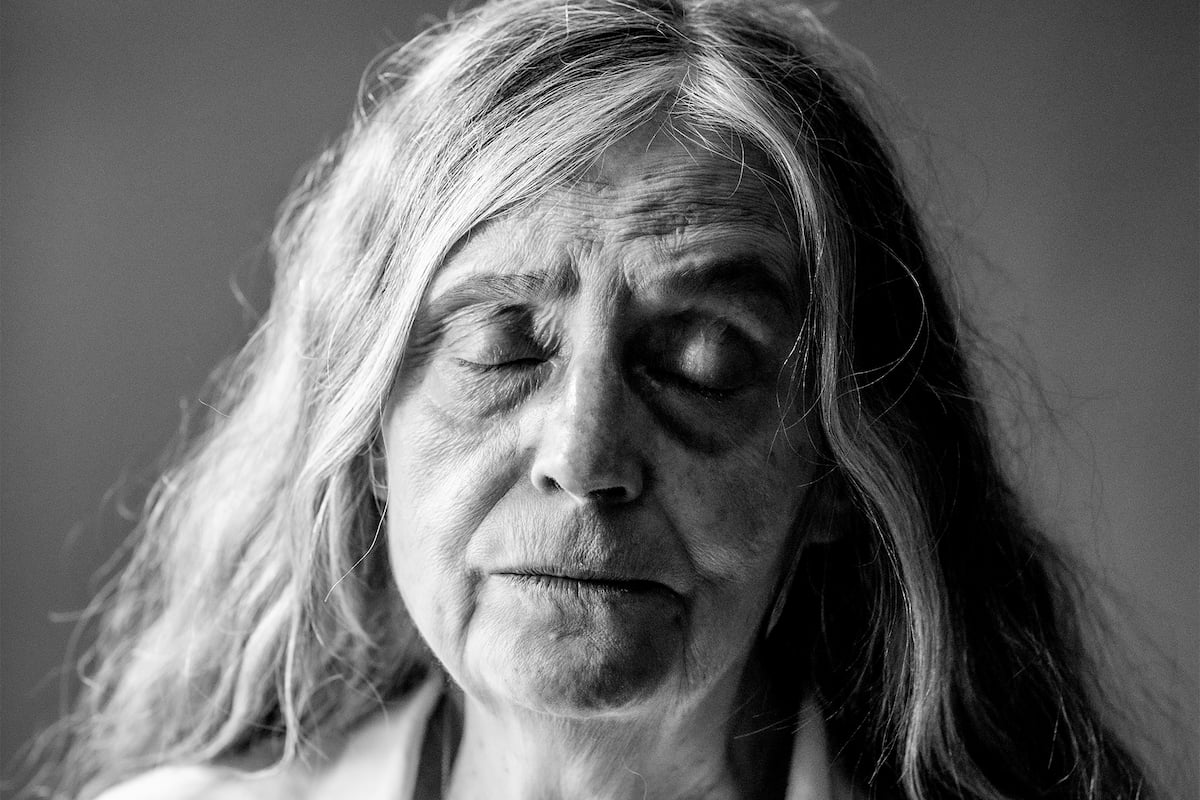
I understand that the only way to approach Alice Notley (1945-2025)—to write with, through, about her—is to go through a dream. Reading Notley’s poems, like all kinds of dream-work, it is best to accept that their meaning will most adequately emerge as something intuitively understood rather than logically known. Trying to explain why someone is your favourite poet is not unlike trying to describe the content of a dream; it reveals the kind of vulnerable detail and irrational meandering that is perhaps best kept to yourself. And yet.
Just as in dreams, the perspective in Notley’s poems is slippery, constantly in flux. There is almost always an “I” but it’s not the stable “I” of a reliable first-person account. Notley’s “I” is ambivalent, mercurial, sometimes startlingly intimate and other times, wilfully antagonising and opaque. By her own admission, “I say ‘I’ so you can understand me / but only I know what I am / at this micropoint in the wind that I am also.” It’s an I that is sometimes a we that is sometimes a they that is sometimes no one at all. In a statement on her ‘Poetics of Disobedience’, she suggests that the ‘I’ creates a poem’s sense of urgency, but that also “the self means ‘I’ and also means ‘poverty,’ … who you are when you’ve stripped down.” Notley’s I is a self sometimes; other times it’s an eye the poem looks through or out of. It can also be a backbone, or a pillar to lean on, or the spine which holds the poem upright. And Notley’s poems are often very vertical; “long blowy sentences all down the page,” as she once described them. Sometimes, the poem is a dream blowing around the pillared I/eye to which it clings.
In ‘Little Egypts,’ her I is staccato and disassociative: “I am in one’s own person, / I am an engrafting, / I am the traffic for several hours. I am expressing / affection in handiwork.” Notley’s I is sometimes collective; a social I/we as in her poem ‘I the People’, in which “I am a late Pre-/ in this dawn of / We the people / to the things / that are & were /& come to be.” Sometimes Notley’s I harmonizes with a chorus of her dead. In one of her most well-known poems, ‘Your Dailiness’, she writes “Several months before I met my husband / I began to concentrate on ghosts, that they were there, / there here, and I, I might see one, if anyone why / not as with anything, I?” Later, in an interview in the Los Angeles Review of Books, she elaborated: “Dead people talk to me. I don’t know what they are doing precisely. A lot of my recent work is trying to find out what they are doing.”
Notley’s dead were many—I am not the first to suggest that her poems frequently move along the trajectory between the Cassandra-like channelling of a medium and an endless correspondence between the living-Alice and all of her deceased. She survived, among others, her first husband, the mysterious and brilliant older poet Ted Berrigan, and then her stepdaughter, Kate Berrigan, then her brother Albert, a Vietnam war veteran, and then her second husband, the British experimental writer Douglas Oliver. After all this loss, she’d eventually ask, “Death the wind calculating your lesson— / hast thou learned a thing?” Before that, she’d put it more simply: “how many of death’s teeth have I stolen?” Some questions exist in spite of their answers. Gravestones jaunting upwards always made me think of crooked teeth. Notley wrote with her dead as if it were the most ordinary thing in the world. Which of course it is, but other writers tend to forget. Two things it is good to remember about the dead is that they outnumber us by exponential quantities, and also that they have always already won because they can be in two places at once: wherever it is the dead go, and also here, which is to say, everywhere, all of the time.
Yet, alongside her shaky, shimmering “I”, certain stable biographical facts do exist: Alice Notley was born in Bisbee, Arizona in 1945, but grew up in the brilliantly named town of Needles, California. She was a Scorpio. In 1977 she wrote of her hometown:
I was brought up in a small town in the Mohave Desert
The boys wouldn’t touch me who was dying to be touched,
because I was too quote
Smart. Which the truck-drivers didn’t think as they
looked and waved
On their way through town, on the way to my World
But what was her World? She left the desert in 1963, first to attend Barnard College and then the Writers Workshop in Iowa. She initially practiced short fiction, but soon gravitated towards the poets, she said, because they were more bearable to be around when the fiction writers only talked about “agents and stuff.” She started writing poems herself immediately after hearing the Black Mountain legend, Robert Creeley give a reading and a lecture. But it really didn’t seem like either of those colleges were quite her World either—she would later become critical of writing MFAs, calling the “befoibled guys” of the “Iowa style” “the most stupid people in the world.” Still, Iowa was where she met her first husband, the brilliant, intimidating older poet Ted Berrigan, a visiting writer who gave her the keys to his office so that she could read from his library, and that was that. They entered many Worlds together, living a peripatetic, bohemian existence. She described it as “outlawish.” They wrote constantly, they lived precariously, mostly on St Marks Place in NYC, where Berrigan had helped set up The Poetry Project in 1966, but also for stints in Wivenhoe, England where Berrigan was teaching; and Long Island in a garage owned by the painter Larry Rivers; and also for a time in a chicken coop in the hippy enclave of Bolinas, California where lots of other poets were hanging around—Robert Creeley and the great Joanne Kyger among them. That era in Bolinas has been romanticised by many, myself included, as a kind of poet-artist-utopia, but in an interview with the psychoanalyst Hannah Zeavin, Notley, who has always been suspicious of groups or group-ideologies of any kind, said about it:
Oh, it was horrible there… Everyone there had goats, and they wanted you to read your poems out in a field while their children were running around making noise. You can’t imagine how horrible it was. I got pregnant with Anselm while we were living in the chicken house, although I didn’t know it at first. I started feeling sick, so I went to this hippie free clinic, and they gave me tincture of cinnamon or something. Completely useless people.
They had two sons, Anselm and Edmund, now both poets too. They settled in an apartment at 101 St Mark’s Place, a stone’s throw from the flat where one of Notley and Berrigan’s biggest influences, Frank O’Hara, had lived in the early sixties. Then Berrigan died in 1983, from complications of hepatitis, a disease for which Notley herself would later be treated. (As she’d write: “I face my old love, no one / I gave you the illness, he says. / It doesn’t matter”.) She grieved and wrote and raised her sons and, allegedly, obsessively read detective novels. It is safe to say she felt herself irrevocably changed. Around the two-year anniversary of his death, she wrote her long poem, ‘At Night the States.’
‘At Night the States’ is my favourite poem. I don’t know what that means but it is a poem I have been reading over and over. And listening to—repeatedly playing the recording of Notley reading it in Buffalo in 1987. It is not a poem I understand but I have no desire to undo its mystery. Notley’s peer, Fanny Howe, warns us that, “If the dream’s curious activities are subjected to an excess of interpretation, they are better forgotten.” She fears this same “demystification” can happen with too close a reading of a poem. Sometimes analysis strips away all of the magic, and Howe advocates instead for reading in a state of bewilderment. Surely bewilderment is the real last stage of grief, the one that just goes on. Notley described writing ‘At Night the States’, two years after Berrigan’s death, as an attempt to write a final elegy for her husband. I don’t think this means it is also an exorcism—there is no removing the dead in Notley’s World; it feels something more like surrender, the bewildering acceptance of a death that won’t end.
What are the states? States of being, states of mood, of mind, of weather. There are also several geographical states—as in United of America—listed in the poem too: Maine, Florida, and Washington all crop up, anchoring the poem’s numinous sadness in improbably concrete locations. Perhaps elegy itself can be best described as a kind of state. An elegy is a kind of poem, just as a sonnet or villanelle or ghazal are all kinds of poems, but an elegy doesn’t have any kind of formal prerequisites in the way those others do. In this way, perhaps an elegy is not quite a form but a state you enter into—a place, or a mode of being. I wonder if those within the state of elegy recognise the other stricken poet-travellers who have found themselves there? Or if an elegy is a state you enter on purpose, or if it catches you off guard, like a sudden change in the weather? But that’s not quite right either, because everyone around you would experience the weather too—an elegy is a state you enter alone. The state of elegy is distinct from the state of grief, because although grief is something entered and all-consuming, elegy is something you do with it. ‘At Night the States’ is full of that helpless grief: “how I / would feel. Shirt / that shirt has been in your arms / And I have / that shirt is how I feel” she writes with plain desperation. Later, by absurdly evoking the Simple Minds song ‘Don’t You (Forget About Me)’ which was charting at the time, she describes, perhaps better than anyone, the absolute ridiculousness of Death’s appalling indifference: “will you still walk on by? I / have / loved you for so long. You / died / and on the wind they sang / your name to me / but you said nothing.”
In the second stanza, Notley writes, “do you know what / Of course (not) I mean? / I have no dreams of wake-/fulness. In / wakefulness.” Her wakefulness being where the dream is not, her wake-fulness that liminal state post-death, pre-funeral that stretches out, unheimlich-ly. Before I learned of the death of my own wilfully mysterious older poet ex-boyfriend, his death would appear in my dreams: I would see him drowning in the Serpentine pond in Hyde Park; I would see him caught in the spokes of an old bicycle charging downhill; I would see him begging, wasted, in a doorway, or his limbs splayed at wrong angles over an anonymous pavement. My wakefulness was wary and suspicious. The night the news of his death caught up with me at last, I was already in a different kind of altered state, and for hours I couldn’t be sure it wasn’t just another dream after all. Notley has said that when the dead talk to her, she hears them in her own voice. She has called this phenomenon “a miracle.” When I hear voices in my head, which have grown less frequent over recent years, they are voices I don’t recognise. The only time I was sure I felt my dead ex trying to talk to me, I was on the sixth floor of a too-hot apartment block in Athens, lying on a bed of olive-green sheets, with somebody else’s initials embroidered into the pillowcase. I clamped the pillow around my ears: whatever he wanted to say, I refused to listen.
A dream can be a state too, that much is obvious. When I dream I enter the same places again and again; at night the states transport me to a place so familiar I am often unsure whether it’s a memory or somewhere I’ve been before only in another dream. Years before my poet boyfriend, the first big death I encountered happened when I was sixteen. A boy, a little older, who I had known all my life, decided not to live anymore, eleven days after the last time I saw him. I loved him, in a feral adolescent way, and last saw him alive in his kitchen, pouring a little bit from his beer can out into the cat’s bowl, to see if his cat, Boomerang, would like it. In the fourteen years that have passed I have met him, and his cats, who are now deceased too, several times at night, in the dream state. “If I find your soul do you want it?” Notley writes, “I see it everywhere, past the death visage.” I dream quite clearly the creases of his eyes, and songs he had not yet written. After his death, I knew the world had been pulling the wool over my eyes all along. Now that it was ripped away, I understood something I couldn’t unlearn—as Notley wrote in The Descent of Alette: ““I was sight”, “pure sight” “Was being”, “with no object””. Grief makes a split in you and once you look through the rupture you can never unsee it. Nothing in the world would stave off Death, no matter how many of its teeth you stole: ““he would literally” “take your soul” “Which is / what you are” “below the ground” “Your soul” “your soul rides” // “this subway” “I saw” “on the subway a” “world of souls””. I felt his death go into my bloodstream and settle there the way the ancient sea fossils were permanently etched into the limestone deposits that littered my garden where I lay and wept after the news reached me. I started writing poems after that because I knew death would get into everything then—subways and teeth and gardens and dreams—and because every other form of language felt, of course, inadequate, ridiculous.
The Author’s Note that accompanies my copy of The Descent of Alette reads, “Notley has never tried to be anything but a poet, and all her ancillary activities have been directed to that end.” When I have told people I have lived like this—intentionally precariously, outlawishly, arranging the patterns of my days around the pursuit of writing and dreaming—accusations of “privilege”, of “naiveté” of “head-in-the-cloudness” have been levelled at me. Well, I have made choices in my life and so have you, and things have happened in my life, as I’m sure have in yours, in which I had no choice at all: “At night the states / whom I do stand in judgement, I / think that they will find / me fair.” Notley lived her life in financial poverty, precarity, ill-health and unpredictability: with her second husband, Doug Oliver, she left New York for Paris where she continued to live even after he died, alone in a small studio flat, away from all of her friends and loved ones, primarily because French subsidised healthcare was available to her in a way that it wasn’t in the US, and she needed treatment for hepatitis, and then for cancer. Still, she never stopped writing: she wrote everyday, even in hospital, even when her poems, which grew longer and increasingly opaque after the death of her second husband, would often go years unpublished. Where did she keep them all? I imagine her alone in that tiny Paris apartment, surrounded by thousands of mounting pages. Maybe writing is just a way to pre-eminently haunt, a death-tooth left out like a breadcrumb trail. In one of my favourite early Notley poems, an unusually small one, a future beyond death is imagined both lonely and deeply peaceful: “And who will know the desolation of St Mark’s Place / With Alice Notley’s name forgotten and / This night never having been?”
Fifty years later it seems likely that if Alice Notley’s name is ever forgotten it won’t be for a long, long time. Maybe the future beyond death will be something more like she described in The Descent of Alette:
“In the air that” “she cradled” “it seemed to us there”
“floated”
“a flower-like” “a red flower” “its petals” “curling flames”
“She cradled” “seemed to cradle” “the burning flower of”
“herself gone”
“her life” (“She saw” “whatever she saw, but what we saw”
“was that flower”)
The night after Notley died, I burned some dried mugwort in my bedroom and tried to inhale as much of the smoke as possible. It’s a herb which has no psychoactive properties in wake-fulness, but which encourages expansive dreaming. I wanted a night of big dreams again. I wrote that night a poem which featured a telephone call with wordless static. Like all poems that still exist in their embryonic state of just-written, I didn’t understand it. Six days before, I had sent an email to Notley, expressing what her work meant to me, and asked if she would be open to being interviewed for this magazine. I’m shy and had been on the fence about sending the email for months. I wished I had sent it sooner, but it seems unlikely that I will ever send an email like that again, as the only other poet I have ever approached in that way was Fanny Howe, who also died almost immediately after.
I must confess I considered resorting to something like a ouija board to write this piece, but in the end I didn’t think Notley would approve of a method so gauche. I don’t know why I considered it. I have never written in collaboration with a ouija board before, and besides, why should I trouble the great Alice Notley all the way in wherever the dead go, when I was never even one of her living. I should know better: if her poems have taught me anything, it’s that the dead will come to us, we do not need to seek them out. Sometimes I imagine my dead are assembled like a dancing conga line behind me, but I have learned from the foolish poet Orpheus and know that I should not turn around to look. Sometimes I wonder if they are visible on me—not a stain nor a shadow but maybe a cloak. Yes, I imagine those occasional strange individuals who claim to see auras will see it: my dead worn wrapped all round me like a cloak.
Instead, coming to the end, I remembered the poem I had written the night of the mugwort, and I did something I have never done before: call the telephone number that once belonged to my dead poet boyfriend. I remembered the digits off by heart, of course. I called the line and waited, and then, there, as I knew there would be: the digital crackle of interference. The number you have called is not recognised, an automated woman’s voice told me. Then, like a dream shifts to a new scene, I remembered Notley’s late poem, ‘The Answer is Awe’, which is also one of her best. It begins: “Dream old pay phone ringing in hospital I pick up / receiver voice says ‘The answer is awe.’” I know these conditions though I do not understand it. Yes, I know, I always know: the answer is awe.
Click here purchase the issue in which this piece originally appeared, or subscribe to receive all future issues as soon as they're published.
You can subscribe to our infrequent newsletter here: